Why and how we pay the rent
As National Reconciliation Week comes to an end, we reflect on how we’re tracking on our commitments to support Indigenous self-determination and to uplift traditional, local knowledge and practice.
A very brief personal history of colonisation
I come from a long line of well-meaning European settlers who benefited from access to land unjustly taken from Indigenous peoples. In the nineteenth century, my ancestors migrated from the Netherlands, Ireland, Scotland and England (plus France and Germany at some point) to Aotearoa New Zealand and South Africa.
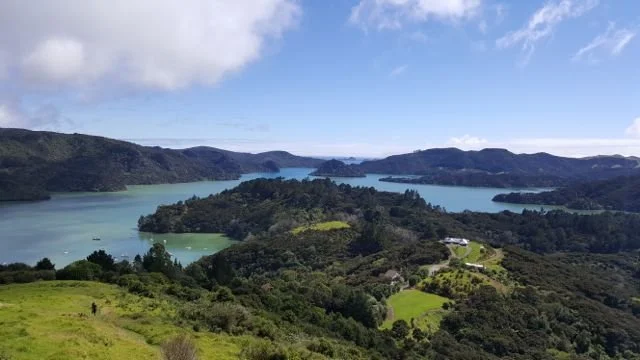
Whangaroa Harbour, Northland NZ (author’s photo)
The beautiful bays of Northland, Aotearoa, where I feel the strongest sense of belonging — where my mother was born and her parents are now buried — are sites of longstanding grievances to which I was oblivious as a child. This area is the territory of Ngatikahu and Ngāpuhi, who in the 19th and 20th centuries, despite numerous petitions to Parliament and Native Land Court cases, lost 97% of their ancestral lands.
My generation has continued the family tradition of migration. As adults, my siblings and I have each settled on stolen land in Australia. These days I’m grateful to live on Wurundjeri Woi-Wurrung Country, not too far from the important site of Coranderrk, and close to some fantastic new Indigenous art by the Onus family and collaborators on the ngurrak barring trail in the Dandenong Ranges.
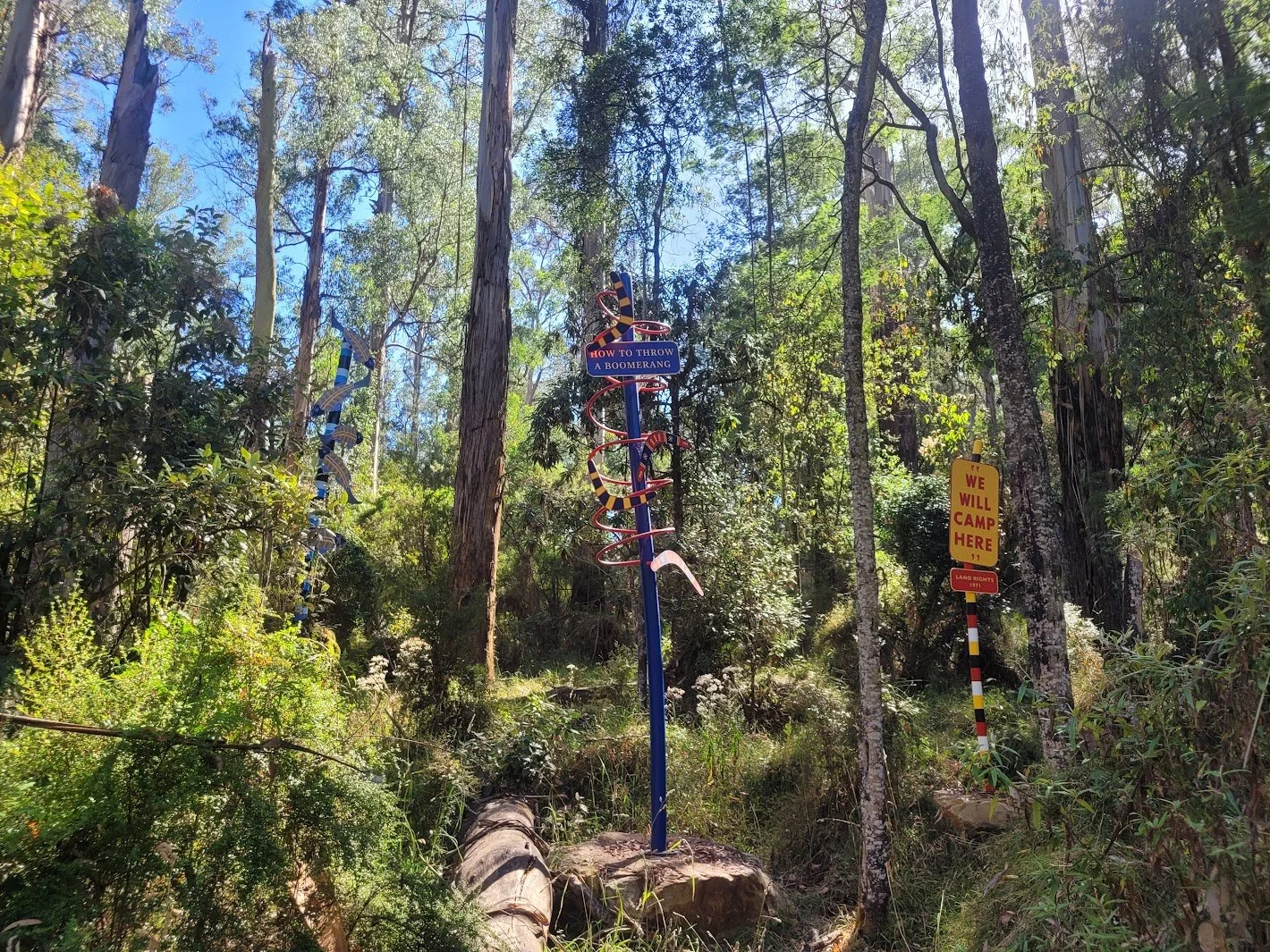
Thrivance by Tiriki Onus and family, Jenna Lee and Jamie Ferguson – part of ngurrak barring (author’s photo)
Aboriginal people have occupied mainland Australia for at least 65,000 years — longer than modern humans have been in Europe and the Americas. They have never ceded sovereignty.
Recent attempts for national structural reform have been thwarted, but here in the State of Victoria, we have at least recently witnessed Australia’s First Treaty between First Peoples and the Government. We have also benefited from this country’s first formal truth-telling inquiry into systemic injustices perpetrated against First Peoples through colonisation.
We now pay the rent
My family, like many others, has unfairly benefited from the continuing dispossession of Indigenous people. We now have an opportunity to address the disproportionate distribution of wealth in this modern nation. One way to do this is by paying the rent — paying at least one per cent of our income each year to First Nations organisations.
We choose to make regular donations to these organisations, for the following simple reasons.
— Wurundjeri Woi Wurrung Cultural Heritage Aboriginal Corporation: we live and work on their land.
— Seed: Indigenous young people protecting Country and fighting for climate justice (First Nations + youth leadership + climate action = win, win, win!)
— First Nations Futures: pooled funding for First Nations community partners focusing on young people, climate action and cultural regeneration.
— Karrkad Kanjdji Trust: supports Indigenous people to connect to and care for their Country in Arnhem Land (when seeking a First Nations organisation to support in the Top End, I heard their longstanding First Nations partnerships quietly achieve a lot).
Last year we also donated to The Healing Foundation in honour of a course contributor who supported participants to build their cultural competency and did not wish to be paid directly.
In previous years, when I wasn’t sure which organisations to support financially, I let go of my colonial ideas about accountability and simply paid the rent here. When living in Aotearoa, I appreciated how easy it was to support community organisations through One Percent Collective.
What more we could do
Though I signed the Open Letter to the Prime Minister, calling for a national truth-telling process, I was not able to physically join the National Walk for Truth or the annual Invasion Day rally. I’ve heard from Aboriginal people that they appreciate allies turning out for these kinds of events.
We aim to uplift contributions and highlight resources from Black, Indigenous and People of Colour in our courses, though when I checked the list of resources added to our Resource Hub in the last month, the creators’ names I recognised were predominantly white. We collaborated with Indigenous consultants and co-facilitators of colour on our Methods Lab, but we have not yet succeeded in attracting larger contracts to form diverse teams on custom services.
We offer two First Nations scholarships on every New Know How public program. As a small social business with a commitment to creating safe spaces for social learning and high quality delivery, we cannot offer many discounts on our courses. We have chosen to hold these places first for Aboriginal, Torres Strait Islander and Māori practitioners, and to offer two, not one, in the hope that the scholarship holder does not feel sole responsibility for representing Indigenous culture on any course.
In 2025-26, we offered five scholarships across six courses. We were delighted to connect with some incredible First Nations artists, consultants and leaders through this process. Some courses had two scholarship holders; others had none.
We would like to see more interest in and uptake of these scholarships. We try to make them as easy to access as possible, with a very short form asking for minimal details, and we also accept applications via email. We are open to suggestions – and encourage others to spread the word about them.
More broadly, we will continue to acknowledge and question the Anglo-European influences on our work, and white supremacy culture more broadly, and seek ways to build cultural safety and elevate voices of the systemically disempowered, without shirking responsibility for our own ideas and actions.
I remain open to feedback and learning, so if anything I’ve written here doesn’t land well with you, or you have ideas for how we can better respect Indigenous wisdom and support First Nations’ struggles for sovereignty, please get in touch.