Who decides who decides?
Shared decision-making is a common aspiration of co-design and other place-based and participatory approaches.
By the time a co-design group is assembled, the shape of the work is mostly fixed: budget, timeline, process model, who’s sponsoring it, which problem is even on the table. That’s not a flaw to apologise for; it’s just true of a commissioned process. The flaw is pretending otherwise.
It helps to get clear, before anyone reaches for a decision-making model, on what this group can actually decide and what’s already locked in elsewhere. Offering people a vote or striving for consensus on something that was never genuinely open is exactly the kind of performative gesture that erodes trust in co-design. Naming the boundary honestly is the first decision-making step, and it comes before any of the models below.
Nine ways to decide
Once the scope is clear, the question becomes: how and when will this group decide, in line with its purpose and principles? Dot voting is not the only option!
One of the things I’ve noticed, as I’ve explored decision-making models, is that this isn’t something many of us are well versed in, even when we work in community-engaged research or participatory design.
This content is from one of the modules of Co-Design Practitioners. Even the experienced practitioners who participate in this program often aren’t familiar with all these nine different ways to make a decision.
— Autocratic: you / your boss / whoever holds decision-making authority has the final say
— Consultative: input is gathered, then one person or a small group decides – a common method in professional settings
— Delegation: the decision is handed to whoever is best positioned to make it – this might be based on their role or their identity
— Democratic: a majority vote chooses from a series of options – what we do in elections; dot voting is a popular version in workshops, but any vote-based method counts
— Consensus: everyone needs to actively agree; often lands on some form of compromise
— Consent: the group proceeds unless someone raises a reasoned objection; aims for “good enough” or “safe enough to try” solutions, not unanimous agreement
— Evaluative: decisions run through a structured filter or set of criteria, e.g. priority matrices (effort vs impact), a feasibility-desirability-viability Venn diagram, risk assessment, or are scored on a set of non-negotiables.
— Random: also called ‘stochastic’; drawing straws or flipping a coin are low-tech versions.
— Avoidant: the decision doesn't get made (yet). That might be deliberate and strategic, due to e.g. a lack of information or ambiguous situation, or unintentional, when a group procrastinates on or diverges from making a decision.
Claude and I developed a graphic to visualise these models based on the time constraints and desired degree of participation. Plotted on two axes — how fast a decision happens, and how many people it involves — these approaches spread out from fast-but-narrow (autocratic, delegation) to slow-but-inclusive (consensus, democratic), with consent sitting in the rare quadrant that’s both quick and participatory.
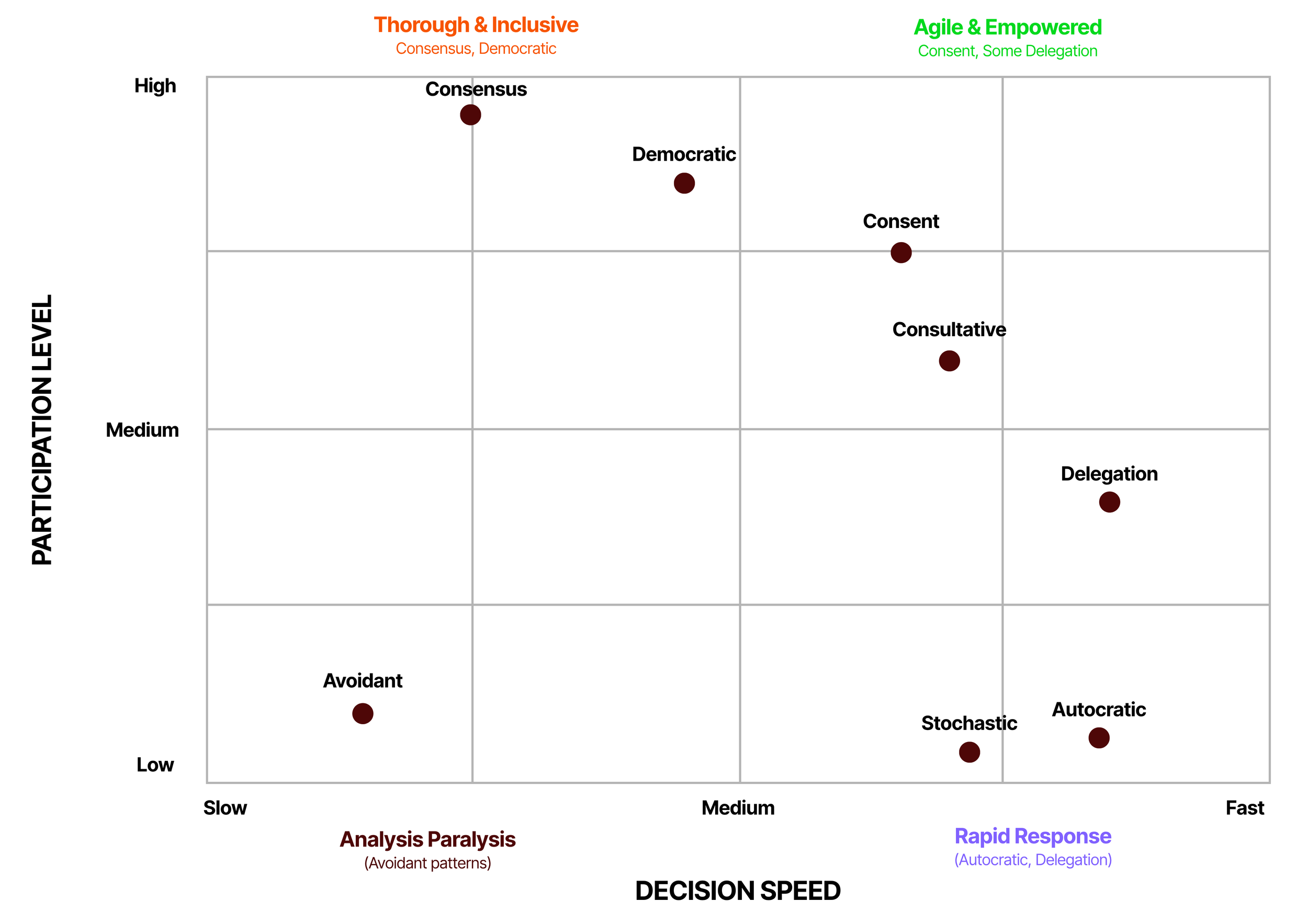
Decision-making models plotted against decision speed and participation level
Why consent fits co-design
For co-design and co-production — where the point is to draw on the expertise and lived experience already in the room, not perform participation while a facilitator or project lead quietly makes the calls — the decision-making model matters a lot.
Consent(-based) decision-making (Sociocracy For All), sometimes called generative decision-making (Percolab), offers a genuinely participatory alternative to consensus, consultation and autocratic defaults. Consent asks a simpler question than consensus does: does anyone have a reasoned objection to moving ahead? If not, the decision proceeds.
Good enough for now; safe enough to try.
This is a truly non-hierarchical way to decide. It distributes power without demanding the full agreement that consensus can take forever to reach. And it respects a principle central to participatory practice: participants already hold expertise; we don’t need to defer decisions upward by default.
If you’re not going to take the time to upskill all participants in a participatory decision-making approach like this, you shouldn’t claim to be sharing power or ‘co-deciding’.
Too often a co-design group is actually treated as a consultative body, not a decision-making body. If that’s the case, be honest about where decision-making power actually lies, rather than pretending a co-design team has it. I’ve found participants don’t necessarily expect to have authority over everything, and are usually quite reasonable when it comes to transparency around existing power structures. Where it gets sticky is when decision-making authority is unclear or misleading.
Tools worth knowing
The Decider App is a useful, low-friction reference for a group working out which model fits their situation. This quick interactive tool helps name and choose an approach before diving into a task, rather than defaulting to whatever's familiar.
For groups making consent-based decisions at scale or asynchronously, Loomio is worth knowing. It's built around proposals people can agree with, disagree with, abstain from, or block, which maps directly onto consent decision-making rather than forcing a vote-based structure onto it. We use it a lot in Enspiral.
Organisations like The Hum and The Ready also freely offer some great resources on shared decision-making for groups and organisations.
How might we choose our process, not just our participants?
Co-design and engagement practitioners are usually deliberate about who’s invited into a process. We’re less consistently clear about how that group will actually decide once they’ve gathered — or honest about what, exactly, is theirs to decide. Naming both, upfront, is as much a design decision as anything else in the process.